

Finding Healing in the Aftershocks of Parental Discard
Parental Discard and the Body’s Hidden Responses

Finding Healing in the Aftershocks of Parental Discard
Thirty-six hours after I thought I’d handled it, the ground gave way.
I had been at my mother’s house on September 16th, helping with her dementia care. Her walls are lined with decades of family photos — the same pictures I locked away in my own home over a year ago because they cut too deep. At her house, I couldn’t avoid them.
I looked. I felt the sting. But nothing “happened.” No collapse, no shaking. I left thinking I was okay.
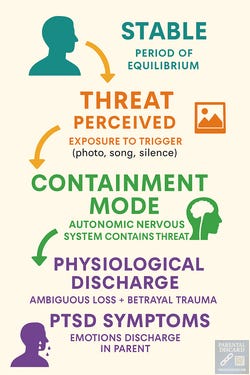
What I didn’t realize: my nervous system had pulled me into containment mode. That’s how trauma protects us — it walls off the wave so we can keep moving. I thought I was fine, steady, even resilient.
But thirty-six hours later, the tears came. Not small tears — gut-level sobs. Then the desperation. Then the questions I can never answer.
When Your Body Delays the Crash
This is what every discarded parent needs to know: the body doesn’t always break in the moment.
In trauma science, the DSM-5 recognizes delayed expression of PTSD — where full symptoms can surface days, weeks, or even months after a trigger. The nervous system can hold activation in containment and release it later when it perceives “safe enough.”
The lag between trigger and collapse isn’t weakness. It’s biology.
The Hidden Triggers That Ambush Us
Parental discard grief doesn’t behave like death or divorce. It’s ambiguous loss — the child alive but gone. It’s betrayal trauma in reverse. And the triggers hide everywhere:
• Objects & environments → family photos, the child’s room, their favorite chair
• Dates & silence → birthdays with no call, holidays where they’re missing
• Daily routines → cooking family meals, grocery shopping, setting the table
• Digital ghosts → old texts, being blocked, social media “memories”
• Indirect wounds → hearing about them through siblings or relatives
The point: triggers aren’t always obvious. They can be anything that collides with your nervous system’s stored memory.
Quick Grounding When It Hits Suddenly
When the delayed wave crashes, try this:
The 5-4-3-2-1 Reset: Name 5 things you see, 4 you can touch, 3 you hear, 2 you smell, 1 you taste. This pulls your nervous system back to the present.
Butterfly Hug: Cross your arms over your chest, hands on opposite shoulders. Tap alternately, left-right-left-right. This bilateral movement helps process the activation.
Give it 20 minutes: Allow the wave, then shift rooms or step outside to reset your environment.
The Healing That Hides in Plain Sight
Here’s what gives me hope: On July 4th weekend, my collapse lasted days. In September, it lasted hours. Painful and shattering, yes — but shorter.
That difference matters. Shorter crashes are a marker of healing, even when they don’t feel like it.
The tears, the gut-level sobbing — these aren’t just suffering. They’re your nervous system discharging what it held too long. They are slivers of healing, even when they hurt.
And when you can look back afterward and recognize what set it off? That’s growth. Recognition after the fact means your mind and body are slowly connecting the dots.
Healing here won’t look like closure. But sometimes it looks like shortening storms. Sometimes it looks like naming what it is. Sometimes it looks like still standing when the flood passes.
⸻
👉 Read the full piece —
including detailed trigger examples, the complete science behind delayed trauma responses, and a comprehensive toolkit for surviving these crashes — at ParentalDiscard.com
Have you experienced delayed grief reactions after parental discard?
→Share your story ←
© 2025 Parental Discard: 21st Century Erasure of Parents™. All Rights Reserved.
No part of this work — including text, frameworks, graphics, audio, or video — may be copied, reproduced, distributed, or transmitted in any form or by any means without prior written permission from the creator. Unauthorized use, duplication, or derivative works are strictly prohibited and will be subject to enforcement under U.S. and international copyright law.